GUEST-BASED MARKETING
How to Increase Restaurant Sales Without Breaking Your Budget
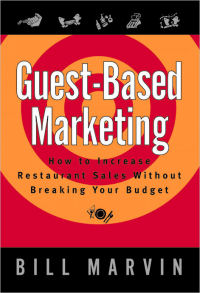 Hardcover, 225 pages, 6"x9" Hardcover, 225 pages, 6"x9"
Copyright 1997
Published by John Wiley & Sons, New York, NY
80.00

AUTHOR'S SUMMARY:
Guest-Based Marketing is about how to build sales without breaking your budget; about how to build volume from your existing
customer base. More specifically, it is about how to treat your guests in such a way that they want to come back more often and say wonderful
things about you to their friends!. Every restaurateur wants to build sales but nobody has an endless supply of money and most operators have had
only limited success with more traditional sales-building techniques and approaches. GBM will show you a way to boost volume that is simpler,
more effective and much less risky than anything you have ever tried before.
DUST JACKET COPY:
"...operators are spending more and more time worrying about the market, looking over their shoulders, counting cars
and trying to outguess the new guys. When they ask me what they should do, I tell them to stop trying to compete!" - Bill Marvin, The Restaurant
Doctor
Increase sales by not competing? No, this isn't some sort of New Age Marketing mysticism. It's part of an amazingly successful, common sense
approach to restaurant marketing that author Bill Marvin calls Guest-Based Marketing.
What exactly does "guest-based" mean? It's really pretty simple. The dynamic marketing approach described in this book is based on the notion
that in the restaurant business, customer satisfaction is the real bottom line and that any successful sales-building effort begins on the floor
with the guests you've already won.
In Guest-Based Marketing you won't find clever new ways to squander your precious resources trying to beat the competition and steal
their customers away. You will find sales-boosting techniques that will help you to motivate your customers to keep coming back for
more, even if it means driving an extra mile or two. Using numerous case studies and real-life anecdotes, Marvin describes proven techniques to
help you:
- identify and build on your strengths
- build customer loyalty
- increase the number of visits customers make
- get your customers to spread the word and attract new diners
Marvin teaches you how to launch an effective customer loyalty program and use an array of incentives to build sales. He helps you hone your
all-important people skills. You'll learn techniques for remembering guest' names, as well as their individual likes and dislikes. He shows you
how to conduct customer surveys and make the best use of the information you gather.
Designed for quick reference and featuring Bill Marvin's trademark warm, humorous style, Guest-Based Marketing is an indispensable
tool of the trade for restaurateurs of every variety - truly a working book for working people.
In this groundbreaking guide to restaurant marketing, expert Bill Marvin demonstrates that success doesn't come from beating the competition,
it comes from pleasing your guests. He shows you how to work from the inside out - to build on your strengths and to take advantage of intrinsic
advantages you didn't even know you had. He also suggests dozens of successful, low-cost techniques for mining the most precious resource at your
disposal - your existing customer base. Among other valuable lessons, you'll learn how to:
- educate your guests about why they come to your restaurant
- implement sure-fire incentive and customer loyalty programs
- manage a successful word-of-mouth campaign that gets your guests to do your advertising ... for free
- get your staff involved in an ongoing commitment to customer satisfaction
- enhance the personal connection between your restaurant and your guests
Perhaps the most important lesson you'll learn in Guest-Based Marketing is, as Bill Marvin puts it: "Monetary joy will come when your
sole concern -- your driving passion -- is how you can excel."
COMMENTS FROM THE PROS:
"Bill Marvin has been laying a foundation for practical hospitality marketing for years and now Guest-Based Marketing is the capstone of a
masterpiece - hands-on, practical stuff for those in the industry and for those who would be in the industry. Today's very competitive
marketplace demands guest-based marketing skills and focus - a most valuable book at precisely the right time."
-- Michael E.
Hurst, Professor, Hospitality Management, Florida International University, Past President of the National Restaurant Association and
owner of Fifteenth Street Fisheries Restaurant, Fort Lauderdale, FL
GUEST-BASED MARKETING
How to Increase Restaurant Sales Without Breaking your Budget
CONTENTS
OPENING OBSERVATIONS
Preface
BUILD LOYALTY, NOT THE CHECK AVERAGE
01. Selling Techniques Can Be Dangerous
02. Job One
03. The Problem with Selling Techniques
04. Raising Revenues
05. Understanding Service
06. Sunset Grill: A Case Study
FOCUS ON GUEST DELIGHT
07. Satisfaction Stinks
08. Expectations
09. - service expectations
10. - product expectations
11. Delightful Practices
12. - operating policies
13. - unexpected touches
14. - special occasions
15. - service
16. - food & beverage
17. - teens
18. - families
19. - disabled
20. - elderly
GIVE GUESTS SOMETHING GOOD TO TALK ABOUT
21. Understanding Word-of-Mouth
22. Basic Principles of WOM
23. Why Do People Talk?
24. Who Do People Listen To?
25. A Few Thoughts About People
26. Goals of a WOM Program
27. Differentiate the Basics
28. What Can You Talk About?
29. - concept
30. - operating policies
31. - food & beverage
32. - decor
33. - design
34. - restrooms
35. - pleasant surprises
36. Give Them the Words
37. Establishing a WOM Program
38. What Makes a WOM Program Work?
39. What Will Not Work?
40. Lambert's: A Case Study
41. El Puerco: A Case Study
PROVIDE INCENTIVES TO RETURN
42. Incentives Work
43. Discounts
44. - business card drawings
45. - internal coupons
46. - meal period discounts
47. Promotions
48. - birthdays and anniversaries
49. - holidays
50. - special events
51. - festivals
52. Customer Loyalty Programs
53. - punch cards
54. - point systems
55. - percentage of purchase plans
BUILD PERSONAL CONNECTION
56. It's About People, Stupid!
57. Presence
58. Guest Recognition
59. Get to Know Your Guests
60. - learn and use guests' names
61. - remember guests' likes and dislikes
62. - personal information
63. "Clubs"
GET YOUR STAFF INVOLVED
64. Your Staff Is the Restaurant
65. Tips and Tipping
66. 50 Tips to Improve Your Tips
67. Show Gratitude
68. Make a Personal Recommendation
69. Invite Guests to Return
70. Get the Message to Your Staff
CLOSING COMMENTS
EXCERPT FROM THE BOOK:
PREFACE
Customers for life. The idea is so simple and so elusive. All it means is that you operate in such a way that once a guest is exposed to your
restaurant, they will never be satisfied with any of your competitors. It means that your serious sales-building work happens on the floor with
the guests, not in the office with the marketing plan and advertising schedule.
I maintain that the focus of foodservice management should not be to make a profit but to make sure that the guests are happy. I also concede
that management skill is ultimately measured by the consistent profitability of the operation but focusing on the bottom line alone will not
assure success.
If you take care of your guests, your sales will tend to take care of themselves. If the sales volume is there, the odds are that your costs
will be in line.
Evolution of an idea
If you accept that profitability is what enables you to continue to play the game, my books represent a logical progression toward helping
operators do a better job of pleasing guests at a profit.
Restaurant Basics deals with the small irritations that can accumulate and cause guests to become
disenchanted. It is the only book on customer service written entirely from the guests' point of view and effectively defines the actions that
diners lump into the category of "bad attitude.
The Foolproof Foodservice Selection System is about how to get the right people ... the first time. You cannot make quality products
with substandard ingredients and your staff is the raw ingredient in your service recipe.
Then came From Turnover to Teamwork which describes how you can keep those good people once you have
found them. More specifically, it is about how you can run your organization in such a way that people want to hang out with you! The environment
that causes your staff to stay is the same environment that causes your guests to want to return more often.
The groundwork having been laid, now comes Guest-Based Marketing which examines how to build volume from your existing customer base.
It is an examination of the factors that make you the restaurant of choice for diners who increasingly have more and more options to choose from.
It provides practical, tested ideas that can help you create the sort of experience that will draw guests back again and again ... and at little
or no cost.
The groundwork is important. You cannot entice guests back to a restaurant where they were treated impersonally or unprofessionally. This
uncaring attitude is more likely to be displayed by staff members who were hired haphazardly into a restaurant with a poor work climate.
Now that all the pieces are in place, we are ready to examine the principles that will cause diners to be delighted with the restaurant, vocal
in their support and loyal in their patronage.
Restaurant Reality
Every restaurateur I know is engaged in the exercise of increasing (or trying to increase) sales. There seems to be some sort of preoccupation
with the notion that bigger is better or that if we do not exceed last years sales we are somehow falling behind. Both of these points are
debatable but the obsession with maintaining growth is undeniably a stress factor for many operators.
The increasing number of competitors in the market only complicates the process and adds to the frustration. In addition to the normal
increase in independent operations, many chains are now entering second and third tier markets as their primary markets reach saturation.
Multi-Unit Operators
Chains are serious competitors who bring some real clout to the market. Their sheer size evokes a fear response in many independent operators.
They typically have a clearer sense of identity in the market and may enjoy a positive reputation before they even open.
Typically multi-unit operators can bring more professional expertise to the market if for no other reason than that they have more money and
can buy what they need. In many markets, chains are a breath of freshness. They are certainly serious about what they do and have a depth of
capital that makes them hard to beat.
But chains also have vulnerabilities. They are not local and the need for corporate control is often at odds with the need for market
responsiveness at the unit level. Chain restaurants are often impersonal and can leave guests with a feeling of being processed rather than being
served. Their "cookie cutter" consistency has pros and cons but often can be a disadvantage.
They are necessarily slower to react and less flexible in dealing with unique problem-solving than their independent counterparts. Their focus
is often more on costs and percentages than it is on making the guest happy. They also typically have less latitude to be experimental.
Independent Operators
Independents are at a disadvantage for many of the reasons noted above, but they also have some advantages that a chain cannot match. The typical
independent has a local identity. The operation was started by someone from the area to serve people in the area. Since hospitality is a business
based on personal connection, the local tie can be a strong plus. Interestingly, independents may be seen as more personal and friendly because
of their imperfections.
Many locally-owned restaurants literally grew up with the owners and reflect the learning curve in uniquely quirky ways. Independents have to
answer to only themselves and the market, making them far more flexible than their chain competitors. A local restaurant will have a longer
history or tradition than a recently-arrived national or regional operation.
Without the need to support a corporate overhead and with sites that were developed when market prices for land and construction were lower,
the local operator often enjoys lower operating costs. This permits them flexibility that is difficult for newcomers to match.
Independents can be more innovative than chains because they are more often operated by entrepreneurs. All the successful chain concepts grew
from an entrepreneurial dream that worked! Chain executives are quick to admit that they are better at growing an idea than they are at
conceiving the idea in the first place.
Finally, the local operator has an established staff, often with workers who have served guests for generations. There is a legacy there that
no chain will be able to match.
My point in bringing all this up is that competition is a fact of life. If you are successful, someone will move in beside you to try to get a
piece of your business. But no matter where the competition comes from, the savvy operator will play off of his or her strongest market
advantages to stay ahead. Too often local restaurateurs try to compete head-on with the newcomers -- a stressful tactic at best.
Don't Compete - EXCEL!
Nearly every market I visit is experiencing a major influx of new restaurants and it doesn't matter if they are chain operations with deep
pockets and smooth formats or independents trying to carve out a niche or pursue a dream. In either case, operators are spending more and more
time worrying about the market, looking over their shoulders, counting cars and trying to outguess the new guys.
When they ask me what they should do, I tell them to stop trying to compete! Competing can be dangerous to your professional survival! Let me
explain:
Have you ever been driving down the road and had a police car behind you? I don't know about you but when that happens to me, I suddenly
become fixated on the speedometer and fascinated by the rear view mirror. In this condition, I have a lot less time to pay attention to where I
am going! The closer an eye I keep on the cop, the higher my anxiety level rises. I am definitely not as good a driver!
The same thing applies in the business world. When you are watching the competition, it drains vital energy away from your primary focus which
should be on making sure you run the very best restaurant you can. An obsession with your competitors can interfere with giving your guests a
memorable time! Wake up!
Be competitive ... but don't compete. Monetary success and personal joy will come when your sole concern - your driving passion -- is only how
you can excel!
The Best Defense
The best competitive strategy is to never let your guests get to the competition. People are creatures of habit and once the habit is formed,
they are not likely to break it ... unless you give them a reason to do so. But they only come back because they want to!
Every time a guest eats with you is one less shot anyone else has to impress them and win their patronage. So not only do you get the sales
but your competitors do not have a chance to make an impression and win them over.
So the safest way to build sales is to foster repeat business and to be sure that your guests know all the wonderful things you do for them so
that they will be sure to think of you when they dine elsewhere.
Shrinking Market Area
As competition increases, as more and more restaurants enter the market, the distance people are willing to drive is steadily declining.
Mike Hurst of 15th Street Fisheries in Fort Lauderdale, Florida estimates that ten years ago, his guests came 15-20 miles for dinner. Today,
he says, the majority of his diners live within 2 miles of his restaurant and the radius is slowly tightening. People may drive past two or three
other restaurants to get to you but, unless you are a destination restaurant, they are not likely to drive past twenty or thirty.
Guest-Based Marketing
So your most realistic option to build sales has to come from guests who are already within the acceptable travel distance ... and your dining
room is full of them! The trick now is to be able to get them back again and again and that is the basis of what we are calling GBM or
Guest-Based Marketing.
You will find the following pages full of hints on how to build volume from your existing customer base without losing your shirt in the
process. But a word of caution before we get started: you will do better to understand the reasoning behind the ideas offered than to simply
adopt the ideas. The notions I present are not extensively documented for precisely that reason. Too much detail might make this look like a
how-to book when it is really a why-to book. Not every suggestion is appropriate for every restaurant (and adopting all of them is
inappropriate for any restaurant!)
My goal is to increase your understanding of how to build volume from your existing customer base not necessarily to put more toys in your toy
box. If you understand what I am pointing to and the principles that make it work, you will be able to identify and implement your own unique
programs and never run out of ideas.
I encourage you to share your stories, both good and bad, and to contact me with any comments, suggestions or questions. My address and phone
are included at the end of the book for just that purpose. Good luck and have fun!
|